
kufstein
Kufstein
City tour
The starting point of this tour is Hotel Stadt Kufstein – your home away from home. The Realgymnasium (a federal math and science-oriented secondary school) is located one street over to the south on Schillerstraße 2. This school was founded in 1907. The magnificent building from the turn of the century was built in a “Munich Heimatstil” or Domestic Revival style. The building and auditorium are protected as historical monuments.

Villa Maria and the Kufstein villa district
Renovated down to the last detail and lovingly designed, the townhouse ‘Villa Maria’ is located across the street at Josef-Egger-Straße 4. Following the street to the east, you can at least catch a glimpse of the ‘Kufstein villa district’, which continues along Pienzenauer-Straße and ends in the park area with a small Kneipp facility. We will come back to this area at a later date. For now, however, we will stay with the grammar school.
District administration and sewing machine museum
Not far from there is the Kufstein district administration office at Bozner-Platz 1. The building was designed by Viennese architect Philipp von Mitzka. Modelled on the style of a Baroque mansion, the axial building was constructed in just one year and opened in 1914. Its portal and bay window are characteristic features. Josef Madersperger, master tailor and inventor of the sewing machine, has a small sewing machine museum dedicated to him in his birthplace at Kinkstraße 16. The museum is open to visitors. The view is directed towards the town's primary school opposite. Built according to plans by architect Willy Graf and completed in 1912, the building with its distinctive façade impresses with its harmonious ensemble effect. On the north side of the property, at Josef-Egger-Straße 2, there is an imposing entrance portal that is well worth seeing and can be reached via a staircase.
Primary school and Egger Villa
Across the street at Josef-Egger-Straße 3 stands the Egger Villa, now a listed building. It was once the residence of the mayor. The walk now continues westwards, directly into the town centre at Oberer Stadtplatz 15. The striking yellow building is the former primary school of the town, later the administrative building of the local public utilities, and today an office building for tax consultants and auditors with business premises in the health sector. Arcades and decorative elements reaching up to the roof give this building a special significance.
On the way to the town centre, you will pass almost unnoticed the monument to Anton Kink (1820–1868), founder of the Austrian cement industry and mayor of Kufstein. The Kramsach sculptor Peter Schneider is responsible for the monument's current design. It was erected in 1963 to replace an older monument, but on the same site.
St. Vitus Parish Church and Trinity Church
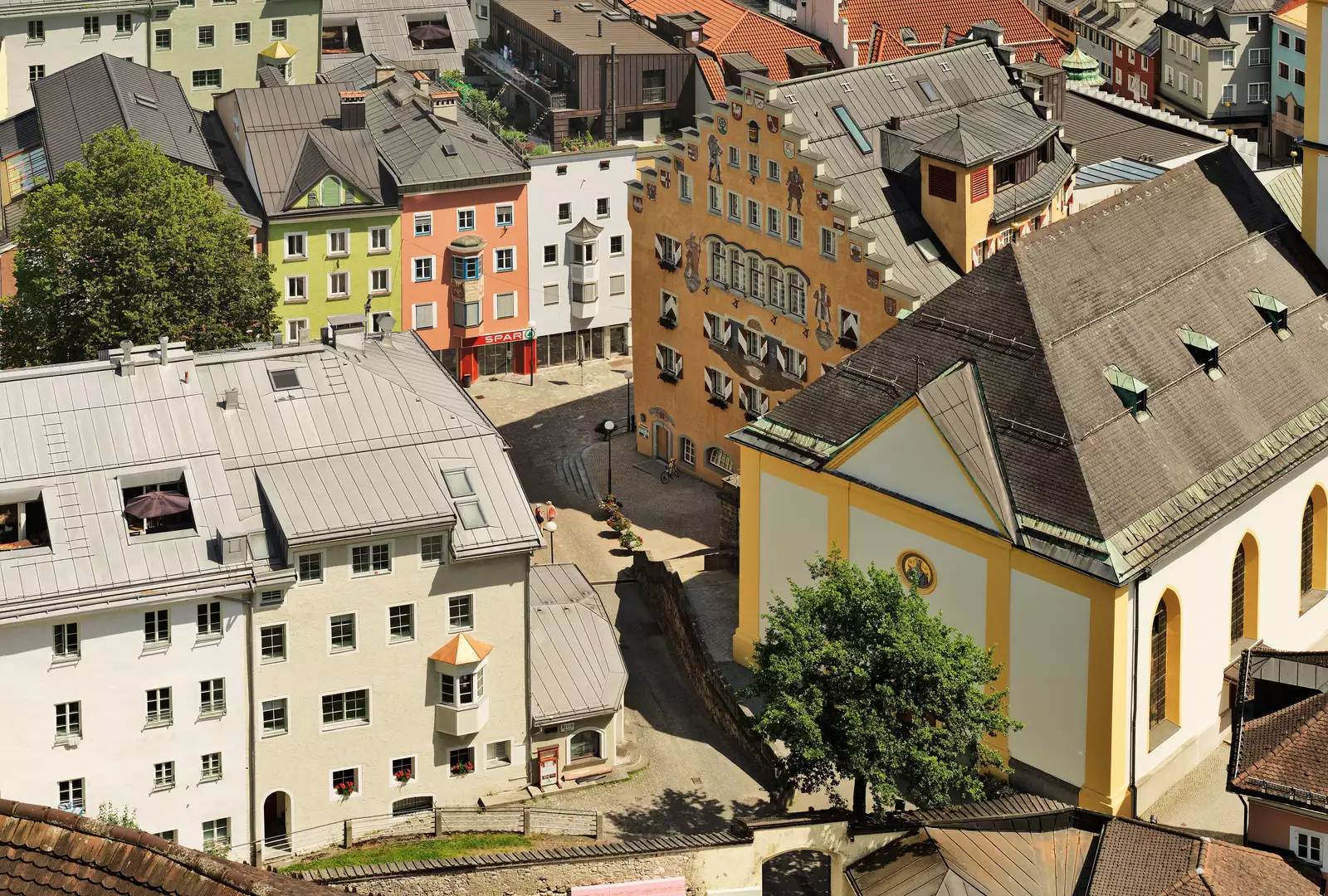
The ascending stairway to St. Vitus Parish Church and Trinity Church above the former Augustinian bastion is impossible to miss. Due to military intervention, the once Gothic spire was replaced by a Baroque onion dome because it obstructed the artillery's field of fire. It is worth taking a look and lingering in the Gothic building, completed in 1420, which was baroqueised in 1660/1661 and is a three-nave hall church with a choir.
It is also worth visiting the Trinity Church with its crypt, located on Pfarrplatz, which is richly decorated with relief frescoes on the outer wall and adjoins the vicarage and the sacristan's house. The church and its associated buildings are listed as historical monuments. The Roman Catholic parish church belongs to the deanery of Kufstein in the archdiocese of Salzburg. Walking around the church, you will come to the Pfarr- or Paramentenstöckl, which offers an eagle's eye view of the upper town square.
Town hall and former Hotel Egger
Here you will find another entrance to the town hall and a memorial stone commemorating the establishment of the town twinning between Frauenfeld and Kufstein on 4 June 1988. You have now reached the town hall at Oberer Stadtplatz 17. It is the most important public building and was first mentioned in documents in 1502. Its history certainly goes back further than that. Used as a self-governing house for the citizens, as a school building and often undergoing renovations, it has never lost its original purpose. Originally equipped with a trench roof and trough gutters, thus most closely resembling the city centre architecture, it was given a new look after further renovation in 2011, including the historic ‘Bildstein House’, according to plans by architects Köberl / Giner / Wucherer. Adapted to the requirements of today and the concept of the Unterer Stadtplatz pedestrian zone.
The former Hotel Egger, with its adjoining hall of mirrors, stands on the upper town square as a magnificent building with a listed façade and prime location. It ranks as one of the most representative buildings alongside the town hall and the imposing Sparkasse building. Originally a brewery and village suburban house with an inn, a neoclassical building with a tent roof and rusticated base was constructed in the second half of the 19th century. The front steps were equipped with a spacious terrace and artistically designed stone balustrade. The new hotel building was completed in 1909. With its 75 rooms and modern amenities, the hotel was a hallmark of the hotel industry in Kufstein. All significant events and important signings took place in the Empire-style hall, which could accommodate 150 guests and whose walls were decorated with marble and pear wood. As a theatre hall and later the Egger cinema, the building was frequented by the people of Kufstein as well as visitors and guests to the city. Today, it serves as a residential and commercial building with small shops and restaurants, with the ‘Spiegelsaal’ (Hall of Mirrors) with its glass ceiling being particularly worth seeing.
Lower town square with Hörfarter monument
From the Upper Town Square, now equipped as a shared space, the walk leads past the town hall to the pedestrian zone of the Lower Town Square. Here, the town hall presents itself on the west side with a stepped gable façade, which was built in 1923 as part of a renovation and has remained untouched as a striking feature. The entrance to Kufstein Fortress, with access to the daily lunchtime performance of the Heldenorgel (Heroes' Organ), and the monument to Kufstein Dean Matthäus Hörfarter are impossible to miss. Hörfarter was a man who worked tirelessly and pioneered efforts on behalf of the town and its population. His most important initiatives were:
- Founder of the Kufstein section of the Alpine Club
- 1876: Construction of the Kienbergklamm baths and founder of Kufstein's reputation as a climatic health resort
- Special services to kindergartens, associations and schools
- 1870: Founder of the first kindergarten in Tyrol and the first training course for kindergarten teachers.
His many years of effort ultimately led to the establishment of the state secondary school (grammar school) and the primary school building. His commitment was particularly focused on cultural and community life. Music school, choir, orchestra and theatre association. As chairman of the beautification association – later the Association for Local History and Heritage Protection in Kufstein, or the beginnings of the tourism association – he laid the foundation for many activities in and around Kufstein. In addition to the design of the square in front of the town hall, including the church entrance, based on plans by Munich-based architect Otto Lasne, the town fathers erected the Hörfarter monument in gratitude and appreciation of his services and unveiled it in 1899 (it was re-erected in the 1950s after the Second World War).
The Hörfarter monument was designed by Norbert Pfretzschner, a native of Kufstein, and is a naturalistic bronze portrait bust in the neoclassical style. The wall fountain monument is made of marble with a water basin, a gable motif on the back wall, double columns and a monumental arch with a coat of arms cartouche.
Town houses and St. Mary's fountain
The town houses in Kufstein are lined up in a closed formation on the lower town square, but feature numerous bay windows. This is typical of the 14th and 15th centuries. Striking, graceful and a popular photo motif: the 19th-century Marienbrunnen fountain. The octagonal cast-iron fountain is adorned with a gilded Madonna figure from the late Gothic period. The Virgin Mary and Child are protected by a four-column, tower-like pinnacle canopy with a pointed gable, richly decorated with crabs (stone-carved, wrinkled leaves). The Römerhofgasse, formerly known as Rennhofgasse and Bindergasse, leads to Kufstein's old town.
Many associate the staggered houses with an image from medieval times. However, they are of later origin. At that time, Römerhofgasse also housed a bathhouse with a practising doctor. Stroll through the alleyway, which consists of two rows of houses with two gates, the remains of the city walls from the late 15th century, at the north and south ends of the alleyway. Today, Römerhofgasse is a popular destination for individual visitors and guided tour groups. Auracher Löchl and Batzenhäusl Schicketanz (the latter currently not in operation) are the most prominent restaurants there, alongside numerous traditional and tourist-oriented shopping opportunities.
Inn Bridge and Praxmarer Villa
Since 2004, Saint John of Nepomuk has been welcoming visitors crossing the Inn Bridge. As the patron saint of raftsmen, millers, boatmen, confessors and bridges, he was chosen to protect the Inn Bridge in Kufstein, having been martyred for upholding the sanctity of the confessional. Even before reaching Kufstein railway station, turning off into Jägergasse 2 leads to a special gem, the ‘Praxmarer Villa’ at the station. This is a prestigious villa built in 1876 in the strict style of historicism. Bay windows and protruding structures, as well as the mansard roof crowned with wrought-iron decorative grilles, characterise this building.
Balustrades and balcony loggias with vertical column grooves are tastefully installed. On the way back over the Inn bridge, you will reach the Inn promenade, which was built in 1974, on your right. The destination is the corner bastion ‘Wasserbastei’, which is made of tuff stone blocks. This historic section of the wall remained after the moat was filled in and the city wall was demolished. Nothing stood in the way of the old town and the suburbs growing together.
Upper Town Square
Our walk takes us back to the Upper Town Square. Either walk through the Eppensteiner Passage and uphill via the Lower Town Square, or via Marktgasse. In any case, the destination is the four-storey Sparkasse building with its tower and stepped gable, which dominates the square. Richly structured, with corner bay windows and a specially designed balcony. The main portal, made of reddish marble, is decorated with high reliefs. Depictions of mule shipping and cement transport can be seen. The building has undergone a fundamental interior renovation, but has been home to the Kufstein savings bank for over a hundred years.
The direction of travel is north, so that Franz-Josef-Platz can be reached. A visit to the Inntal-Center and Kufstein Galerien shopping centres is not planned at this time. Instead, the focus is on the roundabout there.
Kufstein City Park and David and Goliath Monument
We take a look at the monument ‘David and Goliath’. It was created by the priest, sculptor and painter Josef Mühlbacher in 1922. David, a larger-than-life bronze statue, gazes at Goliath's head wound. You have discovered Kufstein City Park, which was opened to the public in June 2020, together with the completion of the third construction phase of the Kufstein University of Applied Sciences. Take a moment to linger there before we stroll past the university building, which also houses an international school. On the right-hand side, you will see the Kufstein State Music School building with the Kufstein City Archives in Krankenhausgasse.
Andreas Hofer Monument
Using your smartphone, navigate to the intersection of Krankenhausgasse and Andreas-Hofer-Straße. The keyword ‘Andreas Hofer’ has been mentioned. Directly at the intersection, your gaze is directed straight ahead, slightly elevated, to the monument to the ‘Tyrolean national hero’ towering above the municipal cemetery. Based on a design by Theodor Khuen in 1913, the casting was completed in 1917 at the Selzer art foundry in Vienna. Originally intended as a monument for Vienna, it was gifted to the city of Kufstein, which unveiled it on 11 July 1926 on Kalvarienberg. This statue is also a listed monument. Follow Andreas-Hofer-Straße northwards. At number 6, you will see the listed buildings of St. John's Church and the rectory of the Protestant Church A. B. and H .B.
Turning right onto Prof. Sinwel-Weg, named after the Kufstein teacher, writer and local historian, we head towards the Hochwandweg trail, which runs along the edge of the forest in a northerly direction, to reach the ‘List Monument’, a historical landmark that we have already spotted. In 1906, 60 years after the death of the economist, economic theorist, entrepreneur, diplomat and railway pioneer Friedrich List, who, deeply disappointed with life, took his own life in Kufstein with a seven-inch travel pistol, the monument was erected in a semicircular colonnade of white limestone. The seated portrait figure made of white marble is set inside it. The inscription ‘FRIEDRICH LIST 1789 1846’ is engraved on the front of the pedestal, and a poem by “Martin Greif” is engraved on the back. The statue was created by the sculptor Norbert Pfretzschner, who signed the figure on the back with his initials ‘NP’. The famous Valentino Casal was responsible for the other parts of the architecture.
Kalvarienberg and Kienbergstraße
Via Liststraße and Hörfarterstraße, passing Kalvarienberg, which is surrounded by small memorial chapels, you reach Kienbergstraße with its stream of the same name and the district of Kienberg or Kienbichl. The romantic street leads slightly uphill through the chestnut avenue, past the municipal kindergarten and forest playground, to the monument to Josef Madersperger, the master tailor and inventor of the sewing machine, whom we have already visited in his small museum on Kinkstraße.
The monument, a bronze portrait bust decorated with oak leaves on an inscribed pedestal, was created by the Austrian sculptor Theodor Khuen and unveiled on 7 June 1903. It commemorates the inventor of the sewing machine, Josef Madersperger. In 1992, the monument was moved from its original location nearby to its current location.
Spindler Monument
The Gasthof Kienbergklamm is only a few metres away, as is the Felsenkeller inn, and within sight is the Spindler monument, the last stop on our tour of sights. It stands gracefully in a small park. Surrounded by nature, tranquillity and the home of the Kufstein riflemen. Schützen-Straße leads to part of Kufstein's villa district. The Kufstein marksmen erected this monument to Johann Josef Freiherr Spindler, born in Kufstein in 1742 and later a colonel, the ‘Hero of Kalafat’, who victoriously stormed the ramparts of the Romanian city against a group of Turks in 1790. The memorial was unveiled on 25 September 1904 in the presence of Archduke Eugene of Austria from the House of Habsburg.
The entire work was created by Kufstein craftsmen, stonemason Härting and metalworker Kruckenhauser. The obelisk with artistic snail-shaped ornamentation rises from a high pedestal and is crowned by a bronze griffin with outstretched wings.
Motor skills park
Your steps and gaze wander towards the Motorik Park with the Kneipp facility mentioned at the beginning. The ‘lungs’ of the city, which merge directly into the city hill. A place to linger, rest and recharge your batteries. Along Pienzenauerstraße, you reach Engelhartstraße on the left, at the end of which stands a truly stately townhouse called ‘Oberst Villa’. Today it is privately owned, but still worth mentioning and seeing. It was designed by Stuttgart architect Willy Graf and built there in 1912.
The curved gable roof is striking. The two bay windows emphasise the symmetry of the villa. Timeless ornaments adorn the façade. A gem in the former cottage district, which developed into the villa district on Kienberg at the turn of the century. The footpath now leads to August-Scherl-Straße 1, past the higher education institution and technical college for economic professions, which connects to Maximilian-Straße. Tall plane trees form a wonderful avenue here, leading to Pienzenauer-Straße. Turning left, you reach Josef-Egger-Straße with the aforementioned ‘Villa Maria’.
Kufstein District Court
But not far from the turn-off to Arkadenplatz, a mighty building rises up on the right-hand side of the street corner. The Kufstein District Court. A towering yet elegant structure, it was built in 1910 in the ‘Munich Heimatstil’ style and features a corner tower with a pointed arch portal. An onion dome with a lantern crowns this section of the building. The interior of the building is also impressive and well worth seeing.
Return to Arkadenplatz
Nothing stands in the way of your return to Arkadenplatz and our hotel. You have earned everything you treat yourself to now. A good night's sleep, a selected programme in our wellness oasis, refreshments in our elephant Kufstein Lounge. We wish you a pleasant stay and a wonderful time!